Posts
Posts


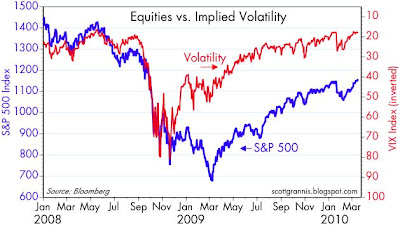
I'm showing this chart for the umpteenth time in order to emphasize a point I haven't made in quite awhile. The chart shows how tight the relationship between implied volatility (a proxy for the market's level of fear, uncertainty, and doubt) and equity prices has been over the past year. As fear and uncertainty subside, equity prices rise. It makes perfect sense, especially since the crisis that set in starting in mid-2008 was all about widespread fears of a global financial collapse.
The point I want to make here, however, is that when the yield on cash is basically zero, and the Fed tells you yet again, as they did today, that cash is going to yield zero for quite some time to come, you have to be consumed by fear, uncertainty and doubt to want to hold on to cash. You have to be extremely, extraordinarily worried that the economy is fragile and likely to suffer a setback; that the housing market is on the verge of another collapse; that the Chinese are going to sell all their bonds and send our yields soaring; that the Fed is going to make a huge inflationary mistake and then have to crush the economy; that Obama and the Democrats in Congress are going to take over the healthcare industry and end up spending trillions more than they are claiming it will cost; that the U.S. government will lose its AAA rating and sink under the weight of many tens of trillions of unfunded liabilities; that no one in Washington, nor any group of concerned citizens in the heartland, will be able to stop this runaway federal government spending train, much less turn it around.
If instead you think that there is a glimmer of hope that catastrophe might be averted; that the economy might manage to eke out a moderate recovery with growth rates of 3-4%; that the political winds are now blowing to the center-right instead of the left; that the housing market, after one year of price and construction stability, can manage to avoid another collapse; that the gradual return of confidence will boost consumer spending and lift the animal spirits of businesses just a little bit; that some people out there have enough of a profit motive to figure out how to put at least some of the economy's many idle resources and workers back to work; then you have no reason to hold cash, and every reason to invest in something other than cash. And as investors who currently hold cash gradually come to understand this line of reasoning, the very act of shifting out of cash will add to the economy's upward impetus and become a self-fulfilling prophecy.
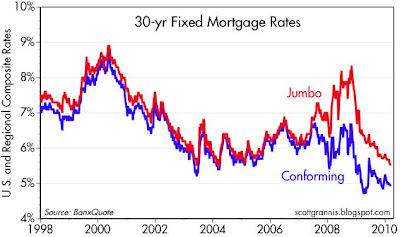
There are many wise investors who argue that the equity market is overvalued, that it has risen too far, that it's another bubble waiting to pop. I take issue with those concerns, because I see plenty of evidence that tells me the market is still very conservatively priced. T-bond yields of only 3.65% tell me that the bond market has virtually no hope of the economy returning to trend growth in the foreseeable future. MBS spreads at historically tight levels tell me that the bond market has almost no fear that the economy or inflation will surprise to the upside. Credit spreads are still at levels that in the past have been the precursors to a recession. Corporate profits are well above average compared to GDP, yet equity prices haven't budged for over 10 years and P/E ratios are only average. On the whole, I think the level of yields, spreads, and equity valuation is only consistent with a belief that the economy will be very weak for a long time, and that downside risks still outweigh upside risks.
So if you are even the slightest bit optimistic, it pays to take some risk these days. And to top it off, that's what the Fed thinks as well, and that's what they are trying to encourage people to do.