Despite the current fears that a Greek default and exit from the Eurozone will have damaging ripple effects, the price of gold continues to trend lower. At just under $1160/oz., it is almost 40% below its 2011 high of $1900. Gold hasn't benefited at all from the Greece turmoil—in fact, it's moved lower. What's going on? I think there are two things happening: 1) declining risk aversion and 2) a realization that the Greek problem is not such a big deal, as I pointed out in a post last week.
Gold needs lots of fear and trembling to move higher. Note that gold prices peaked in the latter half of 2011, right around the time that the PIIGS crisis peaked (second chart, which shows the yield on 2-yr government bonds). Several countries, larger and more important than Greece, were flirting with default in late 2011, and the world feared the collapse of the entire Eurozone. At the same time that gold prices peaked, government yields and 2-yr swap spreads were on the moon. Today, 2-yr Portugal yields are a mere 80 bps, while 2-yr Spanish yields are 42 bps; 2-yr Eurozone swap spreads are only 40 bps. Yields and swap spreads are way down, and gold prices are way down; it's all part of the same story—less panic, a bit more confidence, and liquid, functioning financial markets.
Gold is falling because Greece is not a major threat and there is little or no evidence of any systemic risk. As the first chart above suggests, gold is also falling because the demand for safe assets (e.g., gold and 5-yr TIPS) is falling. (Note that I've used the inverse of the real yield on TIPS as a proxy for their price.) The world is still quite risk averse, as I noted yesterday, and gold is still trading at elevated prices: over the last century, the real price of gold has averaged about $550/oz. But things are slowly getting less risky, and investors are slowly becoming a bit less risk averse.
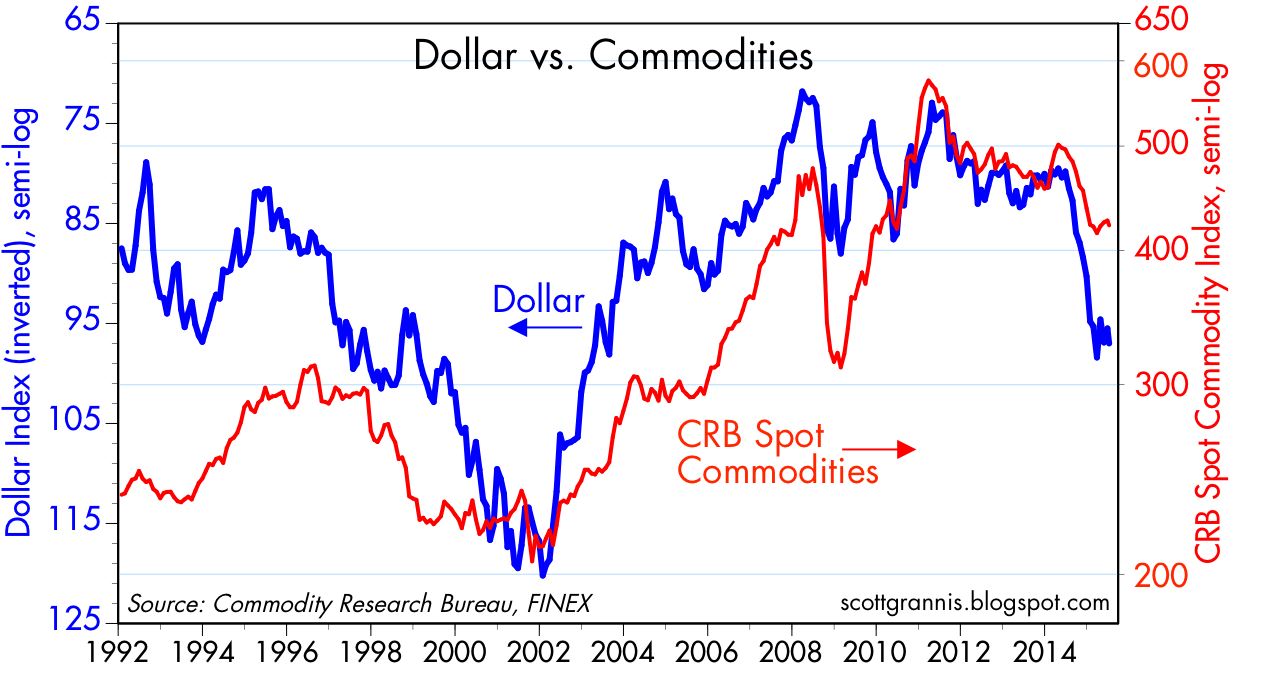
Gold is also falling because commodity prices are falling. Both are falling because on the margin the dollar has been strengthening. Gold and commodities are both a refuge of sorts when the dollar is weak and there are fears that monetary policies will lead to higher inflation. Markets are somewhat less concerned about that now, as inflation has remained quite low throughout the developed world even as central banks have been very accommodative.
Greece is bad for gold because Greece is not a compelling reason to pay up for the safety of gold.
Unless things take a big and unexpected turn for the worse, equity investors will find it hard to justify hiding out in cash, especially when cash pays nothing and yields on alternative assets (see chart below) are much higher, systemic risk is very low, monetary policy is accommodative, and there is no sign of any significant weakening in the economic outlook.
Tuesday, July 7, 2015
Monday, July 6, 2015
Service sector still healthy, so why are interest rates so low?
The ISM June service sector report came in as expected at 56.0, and that is consistent with a continuation of moderate growth in the biggest sector of the U.S. economy. Meanwhile, a similar report for the Eurozone shows conditions have been slowly improving for the past two years. We're still in a slow-growth economy, but nevertheless it continues to grow and conditions continue to improve.
We've had six years of this, and with each passing month the rationale for zero short-term interest rates weakens. Years of near-zero interest rates are now the unique feature of the current business cycle expansion, but the reason for low interest rates is widely and commonly misunderstood. I think it's because central banks have conditioned global financial markets to view extremely low interest rates as "stimulative." Central banks want people to believe they are keeping rates low in order to "stimulate" economic growth. But despite trying really hard for many years to pump up growth, they but don't appear to have been very successful, because growth remains rather tepid. Is that because they haven't tried hard enough, or is there some other reason?
I've argued for many years that zero interest rates are symptomatic of a market that is risk averse. Interest rates on short-term, safe assets are low because the demand for them is very strong. Central banks have been obliged to accommodate this demand for safety by supplying tons of bank reserves. They've set interest rates low because that's where the market has driven them. They haven't been stimulative at all; you can see that by the fact that inflation remains very low. And of course, the premise that central banks can stimulate growth is highly questionable to begin with. Just how does a low interest rate environment stimulate growth? Growth comes from productivity, and productivity is the result of harder and more intelligent work, which in turn requires risk taking and motivation. Interest rates don't factor into the productivity—investment does. Besides, if low interest rates encourage borrowers to borrow, then they most likely discourage savers from saving. When the world is risk averse and wants to hold tons of cash and cash equivalents, investment is naturally weak, and that's why economic growth has been disappointingly slow.
Bank savings deposits—which pay almost nothing in the way of interest—have doubled since the end of 2008, and are now approaching $8 trillion. They have quadrupled in the past 14 ½ years, rising at an annualized 15% per year! Yet they pay almost no interest; demand for the safety of deposits must therefore be intense.
Service sectors in the U.S. and in the Eurozone are in decent shape, as the chart above shows.
The employment subindex fell from optimistic levels, but this series is notoriously volatile from month to month.
The business activity subindex is also at relatively healthy levels.
We're not going to see much in the way of stronger growth until economic policies increase the incentives to work and take on risk, and reduce the obstacles to investment.
Thursday, July 2, 2015
Yet another average jobs report
For the past 4 years, the private sector has been adding new jobs at a 2.25% annualized rate, and the June jobs report released today was simply more of the same. That, coupled with meager growth in productivity, has given us the weakest recovery on record. The good new is that jobs continue to expand and the economy continues to grow, and things continue to get better. And there is no sign of another recession.
The private sector has created almost 13 million jobs in the past 5 years, but the net gain from the prior expansion's peak has only been about 4 million. That works out to a net gain of only about 0.5% per year. We could be doing a lot better: in the 1980s, the net gain in jobs, despite back-to-back recessions in 1981 and 1982, was about 2% per year. That kind of growth would have given us almost 15 million more jobs today.
As the chart above shows, June's gain of 223K was just about equal to the average of the current expansion, but a little better than the average gains of the previous expansion.
On a percentage basis, jobs growth in the current expansion has actually been somewhat stronger—and longer lasting—than in the previous expansion, but a good deal less than the 3.2% annualized growth in private sector jobs in the 1982-2000 expansion.
So what's different this time around? As the chart above shows, transfer payments relative to disposable income have grown some 50% since the 1980s (from 13% of disposable income to almost 20%). Transfer payments represented about 45% of federal government spending in the 1980s, while today they represent almost 75%. To be sure, the baby boomers have added significantly to the ranks of the retired in recent years. But other programs, such as disability, medicare, medicaid, food stamps have experienced explosive growth. We should not be surprised that paying more and more people for not working results in fewer people willing to work. At the same time, the cost of hiring workers has risen, thanks to mushrooming regulatory burdens (e.g., Obamacare and higher minimum wages).
We are unlikely to see a significant pickup in growth and employment until we see pro-growth reforms coming out of Washington (e.g., reduced regulatory and tax burdens, and entitlement reforms).
In the absence of any evidence of deterioration in the economic and financial market fundamentals, and given the continued 2-2.5% growth in the economy, a modest increase in interest rates poses no threat to the economy. Economic growth is slow because of government-induced headwinds, not because of any lack of money or interest rates that are too high. The Fed is likely going to play it safe and wait a bit more to raise rates, but it's not going to make much difference to the economy.
Subscribe to:
Posts (Atom)