Wednesday, June 16, 2010

U.S. industrial production in a solid recovery


U.S. industrial production has risen at a 8.8% annualized pace since hitting bottom in June '09. At this pace industrial production will have completely recovered to its former highs in 12 months. That's fairly impressive given the persistence of the view that we are in a "jobless recovery." It's not a jobless recovery of course, since the private sector has already added more than a million jobs this year. And with industrial production increasing like this you can be sure that many more jobs will be created in the months to come. Furthermore, I would add that the pace and the magnitude of the current recovery both exceed that of the recovery from the 2001 recession. I just don't see why the gloom and doom persists.

Housing market is still in a slow but uneven recovery


There are two ways to tell the story behind today's release of May housing starts: 1) (from Bloomberg) "Builders broke ground on fewer U.S. homes in May than anticipated after the expiration of a tax credit, indicating the real estate market will struggle without government incentives." 2) (from me) Despite an unexpected decline in May, the pace of new home construction was up at an annualized pace of 24% relative to its all-time low in April '09, while building permits were up at an 8.5% pace relative to their March '09 low, suggesting that the housing market's recovery from its unprecedented collapse will be uneven.

In any event, I'm having trouble connecting the May weakness in housing starts to the April expiration of the tax credit. Seems to me that the only way to take advantage of the  tax credit would have been to start construction long before April—as far as I know, we have not yet returned to the days when home buyers were so desperate to buy that they would sign a contract as soon as ground was broken. If the tax credit expiration were to have had a big impact on starts, we would have seen starts decline early this year, but they didn't. What we have is a typical pattern for this series, which is almost always volatile from month to month.


To me its clear that the outlook for the residential construction market has improved dramatically over the past year or so, and that view is confirmed in this index of the stock prices of 18 leading home builders, which is up 110% from its March '09 low. The "worst nightmare" collapse is a thing of the past, and now the issue is how fast the pace of recovery will be. For quite awhile I've expected to see a slow but gradual recovery in residential construction, and so far that's what it looks like. And it's important to recall that the current pace of home construction is still far below what is needed to keep pace with ongoing household formations, so for the foreseeable future the economy's pent-up demand for new homes will be rising every month.

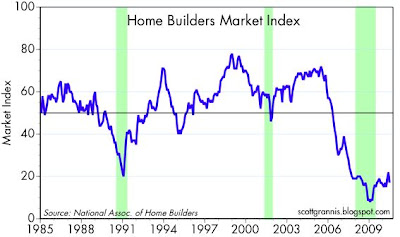
UPDATE: The above charts and conclusions I believe are consistent with the weakness reported in the NAHB release for June that was reported yesterday, and is charted here:

Tuesday, June 15, 2010

Declining swap spreads are very bullish


I don't want to make too much out of this chart, but it is interesting to see how swap spreads have been leading commodity prices for the past several months; note in particular how swap spreads peaked in late May, followed by a bottom in commodity prices in early June. I've long been a fan of swap spreads as leading indicators, since they are real-time measures of financial market fundamentals such as confidence, fear, systemic risk and general liquidity. Commodity prices, on the other hand, tend to lag, but not by too much since they can be driven not only by economic fundamentals (which don't change as fast as financial market fundamentals) but in many cases by financial market speculation (i.e., via futures) which can change fairly fast.

This relationship does not always hold, however. But right now there is a logical link between swap spreads and risky asset prices due to the fears that have surfaced in regards to the Euro debt crisis. Declining swap spreads over the past three weeks are a good indication that Eurozone risks have not found traction in the U.S. economy, and thus that the Euro debt crisis is not going to morph into a threat to the global economy. As the risk of a double-dip recession recedes, it makes sense for investors to return to risky assets, just as it makes sense for corporations to be more inclined on the margin to undertake projects that require commodity inputs. Swap spreads have also been tightly correlated to equity prices recently, and have tended to lead them as well.

Bottom line: declining swap spreads are pointing the way to higher prices for a variety of risky assets.