Thursday, March 8, 2018

Household net worth hits $100 trillion

Today the Fed released its quarterly estimate of household net worth. Things just keep getting better and better. Household net worth as of the end of last year was almost $99 trillion, having risen $7.1 trillion over the past year (+7.8%). As in recent years, gains have come mostly from financial assets (up $27.6 trillion since late 2007), plus real estate (up $2.8 trillion since the pre-Recession peak of 2006), offset by only a $1 trillion increase in debt (total liabilities rose from a Recession peak of $14.6 trillion in 2008 to $15.6 trillion at the end of 2017). Further details in the charts below:

Chart #1

Chart #1 summarizes the evolution of household net worth.

Chart #2

Chart #2 shows the long-term trend of real net worth, which has risen on average by about 3.5% per year over the past 65 years. I note also that recent levels of net worth do not appear to have diverged at all from long-term trends. That wasn't the case in 2007 however, when stocks were in what we now know was a valuation "bubble."

Chart #3

Chart #3 shows real net worth per capita. The average person in the U.S. today is worth just over $300,000, and that figure has been increasing by about 2.3% per year for the past 67 years. Regardless of who owns the country's wealth, everyone benefits from the infrastructure, the equipment, the computers, the offices, the homes, the factories, the research facilities, the workers, the teachers, the families, and the brains that sit in homes and offices all over the country and arrange the affairs of the nation so as to produce almost $20 trillion of income per year.

Chart #4

Chart #4 shows that households have been extremely prudent in managing their financial affairs since the Great Recession. Household leverage (total debt as a % of total assets) has declined by one-third since its Q1/09 high. Leverage is now back to the levels which prevailed during the boom times of the mid-80s and 90s. Unfortunately, while households were busy strengthening their finances, the federal government was doing just the opposite: the burden of federal debt more than doubled from June '08 to December '17 (i.e., federal debt owed to the public rose from 35% of GDP to 75% of GDP).

Thursday, March 1, 2018

Manufacturing sector ramping strongly

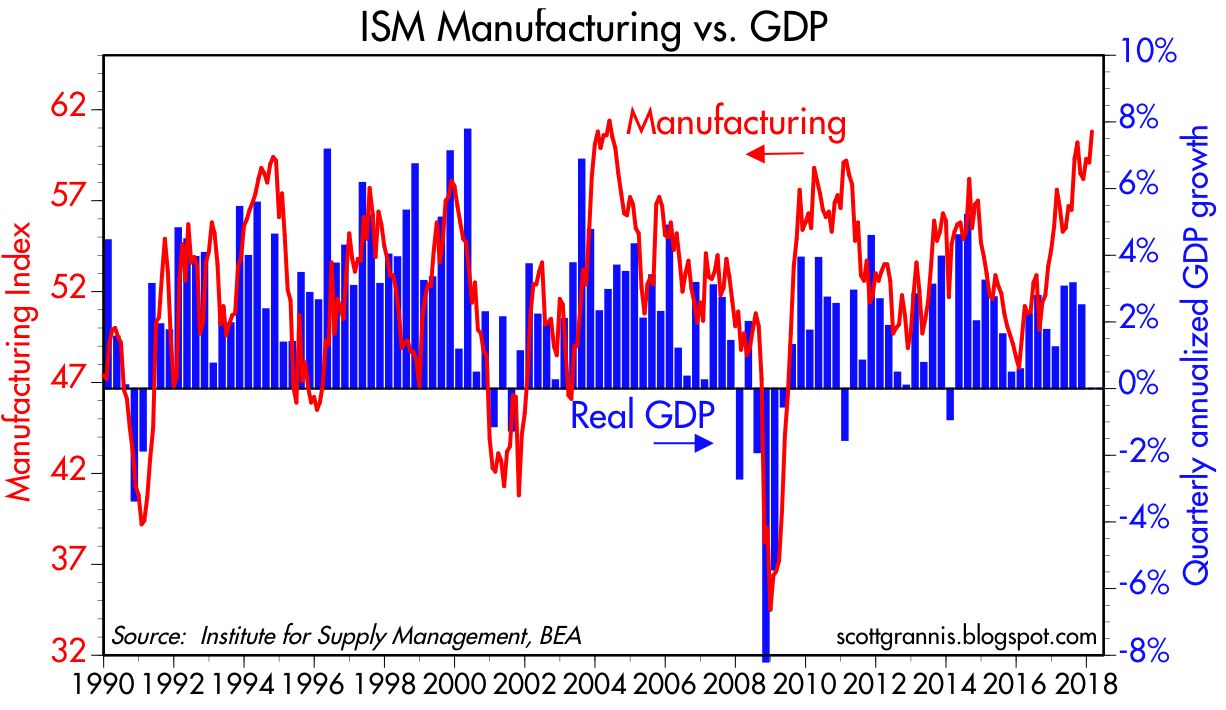
Earlier this year I noted that the manufacturing sector was off to a strong start. Today's ISM releases for February only underscore that point. Things look so good (if you ignore Trump's tariffs) that I'm compelled to post these impressive charts. They strongly suggest that with his tariffs, Trump could be about to snatch defeat from the jaws of victory.

Chart #1

There's been a decent correlation between the ISM manufacturing index and the health of the overall economy. February's number strongly suggests that Q1/18 growth is going to exceed current forecasts of 3-3.5% (according to the NY and Atlanta Fed's models, respectively).

Chart #2

Export orders are coming in very strong, which suggests that overseas economies are doing very well.

Chart #3

The relatively strong employment reading suggests that manufacturers are optimistic about their ability to expand.

Chart #4

This is a lovely picture of a US/Eurozone synchronized manufacturing recovery. The global economy is firing on all cylinders; why would anyone want to mess with this?

Trump's tariffs are cause for concern

Every economist worth his salt knows that tariffs are just plain bad policy. They supposedly "help" domestic producers (subsidize would be a better word), but they hurt just about everyone else. Making steel and aluminum more expensive for US consumers may temporarily help US workers who produce the stuff, but it undeniably harms all US consumers of the stuff. Ultimately there will very likely be many more jobs lost in the industries that use steel and aluminum than jobs "protected" in the steel and aluminum producing industries.

And of course the worst thing would be if this is the first salvo in what could degenerate into a global trade war. That is the stuff of nightmares, and it's the sort of thing that can cause global depressions.

Trump has always been partial to tariffs, and has been roundly and justifiably criticized for it. I was hopeful that it was just bluster, and that when push came to shove the smart people surrounding him would persuade him to desist. That seemed to work for over a year, but apparently it's no longer the case.

Will he really do something so stupid? Stock markets are correct to sell off on the news. We can only hope that a hue and cry and weak stock markets convince Trump to back off. It's hard to believe he could pull such a stupid, dumb idea out of his hat just when the economy is about to ramp up as a result of all the good things he has done.

UPDATE: Mark Perry has an excellent post which demonstrates that the losses from tariffs always exceed the gains, and by a huge margin.

UPDATE: Here's how the market is taking the tariff threat as of 8am Pacific, March 2nd. It's a genuine threat, to be sure, but not catastrophic. Trump is getting TONS of pushback, which may persuade him to back off.