

 Posts
Posts


Today the Fed released its Q1/17 estimate of the balance sheets of U.S. households. Once again, our net worth reached a new high in nominal, real, and per capita terms. We have been struggling through the weakest recovery ever for the past 8 years, yet we are better off than ever before, and by a lot.

As of March 31, 2017, the net worth of U.S. households (including that of Non-Profit Organizations, which exist for the benefit of all) reached a staggering $94.84 trillion. That's up $7.3 trillion in just the past year, for an impressive gain of 8.3%, and up $27.2 trillion since the pre-2008 peak. Of note, household liabilities have increased by a mere $510 billion since their 2008 peak, for a gain of only 3.5%. The value of real estate holdings is up about $1.9 trillion (+7.6%) from that of the "bubble" high of 2006, and financial asset holdings have soared by almost $24 trillion (+45%) since pre-crash levels, thanks to significant gains in savings deposits, bonds, and equities. The gains in wealth are not just due to a raging stock market, since the market cap of all traded U.S. equities has risen by only $8.4 trillion since its pre-2008 high, according to Bloomberg.

In real terms, household net worth has grown at a 3.5% annualized rate for the past 65 years, as seen in the chart above. That works out to almost a 10-fold gain in wealth roughly three generations, and that's impressive by any standard. Perhaps more importantly, there is no sign that this rising trend has been compromised or degraded in the past decade.

On a real per capita basis (i.e., after adjusting for inflation and population growth), the net worth of the average person living in the U.S. reached a new all-time high of $292K, up from $63K in 1950. This measure of wealth has been rising, on average, about 2.3% per year since records were first kept beginning in 1951. By this metric, life in the U.S. has been getting better and better for generations. Real per capita net worth has almost quintupled in three generations.
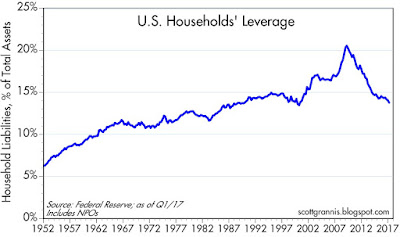
The ongoing accumulation of wealth is not a house of cards built on a bulging debt bubble either, regardless of what you might hear from the scaremongers. As the chart above shows, the typical household has cut its leverage by one third, from a high of 21% in early 2009 to 13.8% by the end of last quarter. Households have been prudently and impressively strengthening their balance sheets over the past eight years by saving and investing more and by reducing the use of debt financing.
Inevitably, skeptics will point out that although the amount of wealth created in the U.S. economy is spectacular, the distribution of that wealth is heavily skewed, being held mostly in the hands of relatively few. Zero Hedge has a good summary of the relevant facts. I (and many others) would argue, however, that the distribution of wealth is not nearly as important as the per capita amount of wealth. Consider: an employee of Apple, now the world's most valuable company (market cap of $808 billion as of today) may have zero personal net worth, but he or she enjoys a job that never existed before. Or consider users of Apple's iPhones who also may have zero personal net worth, but now enjoy more computing power and knowledge in their pocket than was even conceivable just 10 years ago. Increased wealth means more jobs, more opportunities, and more productivity for everyone. Society's accumulated net worth can be seen in buildings, factories, homes, gadgets, streets, and transportation networks, and all of this can be enjoyed and exploited by nearly everyone for their personal gain and/or happiness. It doesn't matter who owns the factory; what matters is how good the jobs are in that factory.


Inevitably, skeptics will point out that although the amount of wealth created in the U.S. economy is spectacular, the distribution of that wealth is heavily skewed, being held mostly in the hands of relatively few. Zero Hedge has a good summary of the relevant facts. I (and many others) would argue, however, that the distribution of wealth is not nearly as important as the per capita amount of wealth. Consider: an employee of Apple, now the world's most valuable company (market cap of $808 billion as of today) may have zero personal net worth, but he or she enjoys a job that never existed before. Or consider users of Apple's iPhones who also may have zero personal net worth, but now enjoy more computing power and knowledge in their pocket than was even conceivable just 10 years ago. Increased wealth means more jobs, more opportunities, and more productivity for everyone. Society's accumulated net worth can be seen in buildings, factories, homes, gadgets, streets, and transportation networks, and all of this can be enjoyed and exploited by nearly everyone for their personal gain and/or happiness. It doesn't matter who owns the factory; what matters is how good the jobs are in that factory.
Free markets and capitalism have proven to be the greatest creators of wealth and prosperity in the history of the world. They maximize wealth creation and opportunity for all, but they can't possibly deliver equality of wealth distribution. To expect it would be to fail to understand how free markets and capitalism work. Some people's comparative advantage lies in building companies and accumulating wealth, while others' advantage lies in supplying the labor that allows capital to be put to work for the benefit of all. Everyone needs each other, and everyone enjoys the fruits of our prosperity. You can't have an Apple without a Steve Jobs becoming fabulously wealthy, and you can't have an Apple without millions of people working to produce and use its products.


