Tuesday, August 7, 2012

The bond/equity disconnect

Very low yields on Treasury securities—and on most developed country sovereign debt, for that matter—are symptomatic of a market that holds out very little hope for growth, and a market that believes that central bank accommodation for an extended period is necessary to (at worst) keep the economy from sinking into another recession or (at best) pump up growth a little. There has been a fairly good correlation between equity prices and interest rates because of this perceived connection between weak growth and low interest rates—until late last year, that is. In the U.S. we now see equity prices approaching post-recession highs, while bond yields are still extremely low. What does this mean? 


One possible answer is that even though equity prices are nearing a post-recession high, they are still depressed compared to earnings and thus reflect a market that is very reluctant to see any good news on the horizon. According to Bloomberg, the trailing 12-mo. P/E of the S&P 500 is now 14.2, and the expected P/E is now 13.1. Both those ratios are substantially below the 16.6 average P/E ratio over the past 50 years.


And P/E ratios are very low considering that corporate profits are very close to record high levels compared to GDP. Very low P/E ratios are thus best interpreted to mean that the market is very pessimistic in regard to the future potential of profits. In a sense, the market is priced to a significant decline in profits, and that would imply that the market believes that growth is going to be miserable in coming years. This market is not optimistic at all. It was extremely optimistic in 2000, as we now know, when P/E ratios were extremely high but corporate profits as a % of GDP were relatively low; back then the market was priced to a continuation of robust rates of growth for as far as the eye can see. Today, in contrast, the market is priced to doom and gloom.


As this last chart shows, the bond market is not entirely oblivious to the improvement in equity prices. The 5-yr, 5-yr forward breakeven inflation rate that is derived from TIPS and Treasury yields (the Fed's favorite measure of inflation expectations) has moved up more or less in line with a stronger equity market in recent weeks, and is now at a one-year high.

My interpretation of all this is that equity prices are improving not because the economy is getting stronger, but because the economy is not deteriorating to the extent reflected in bond yields. Since the economy is not getting materially stronger, the bond market still expects the Fed to stay on hold for a long time, and so Treasury yields remain extremely low. But now the bond market is sensing that the risk of a Fed overshoot—i.e., not reversing its accommodation in a timely fashion—is rising, and that means that inflation could be somewhat higher in the future than the market had been expecting. Treasury yields are not going to rise meaningfully (thus "catching up" to equity prices) unless and until the economy proves to be much stronger than it is currently perceived to be.

Monday, August 6, 2012

Risk of a near-term Eurozone collapse is way down

I have yet to see any meaningful steps taken by the PIIGS to rein in the size and scope of government, and thus I don't think the Eurozone crisis is a thing of the past. But the Eurozone, with the help of the ECB, has made great progress in reducing the risk of a near-term blowup. Markets everywhere are breathing a sigh of relief for what should prove to be more than a temporary, if not a complete, reprieve. 


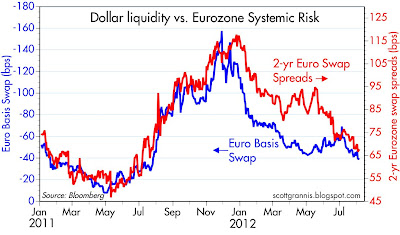
U.S. swap spreads remain quite low, signifying that systemic risk is low, the financial system has plenty  of liquidity, and the outlook for the economy is likely to be improving, if only modestly. Eurozone swap spreads are still somewhat high, but they have declined significantly so far this year.


Euro basis swap spreads have been good leading indicators of this improvement, since they show that Eurozone banks are no longer having much difficulty in accessing dollar liquidity. This may also signify that capital flight out of the Eurozone is moderating. Taken together, these spreads show that liquidity in the Eurozone financial system has improved remarkably, and systemic risk has declined significantly. The likelihood of a near-term disaster is thus much lower. The Eurozone has bought itself a good chunk of time to work out its problems.


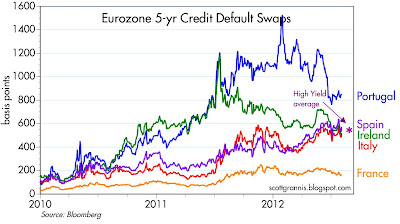
Zeroing in on individual countries, we see that 2-yr Spanish and Italian yields have dropped considerably in just the past week or so. They are not out of the woods yet, but the market is judging that near-term default risk has declined quite a bit.


5-yr CDS show a somewhat different story, since they are driven by the longer-term outlook. We don't see a whole lot of improvement of late, and that makes sense because these countries haven't yet fixed their underlying problems, even as they have made great strides towards remaining solvent for the near-term. Note how French 2-yr yields are almost zero, but French CDS are trading around 150 bps—even the long-term outlook for France remains somewhat suspect. For reference, I've included the current rate on generic 5-yr high-yield corporate CDS, which is trading around 550 bps. Spain, Italy, and Ireland are all considered to be about as risky as the typical junk bond. That sounds a lot worse than it really is, since junk bonds have been excellent investments in recent years, almost matching the total return on the S&P 500 since the rally started in early March 2009 (98% vs. 121%).

Friday, August 3, 2012

Jobs growth still moderate

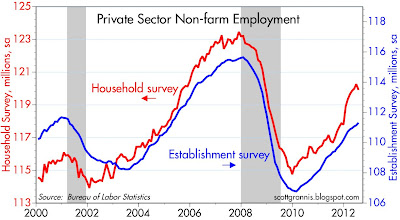
There is no way we are even close to a recession when the number of people working in the private sector grows at a 1.75% annual pace—or about 160K per month—and that is exactly what we have seen so far this year, according to the establishment survey. The increase in new jobs is disappointingly slow, to be sure, but it is not something that can be dismissed as meager or recessionary.


Yesterday I suggested that the July jobs increase reported today was likely to be better than expected, and that proved to be the case (+172K private sector jobs vs. 110K expected). I based that guess on the observation that this year's growth in jobs as reported in the household survey has been much stronger than reported by the establishment survey, and that perhaps it was time for the establishment survey to "catch up" to the household survey. That indeed happened, and as it turns out, the household survey reported a decline in jobs, thus narrowing the gap between the two from both sides. Splitting the difference between the two surveys is a strategy I've always favored, and doing so puts the growth rate of jobs somewhere in the range of 1.5–2.2%. That's just about what the pace of jobs growth was in the 2004-2006 period, in fact. In any event, no matter how you slice and dice these numbers, jobs are growing and there is absolutely no sign of a recession. 


Those in the public sector will disagree, however, since public sector jobs have been contracting for the past three years, with no end in sight. The folks at Brookings lament this fact, but they fail to recognize that there are still many more public sector jobs today than there were in 2000, whereas the number of private sector jobs has barely risen at all. Public sector jobs are declining because of public sector bloat that is being painfully reduced, and we will all be better off as a result, once the dust settles. It's also appropriate to note that wealth is created in the private sector, so that's where it is important to see the growth in jobs.


UPDATE: Today's jobs report also served to vindicate the ADP report from last Wednesday.