It's been more than 30 years that I've been following the monthly employment report, and I've never understood why it is that the market places so much importance on a single number. Especially since that number can and most likely will be revised significantly in the future, it is subject to seasonal adjustment factors that are never completely accurate, and it is volatile from month to month. I've also never understood why the market focuses on just the establishment survey of jobs and almost completely neglects the household survey. Both have their problems, and sometimes they can diverge a lot, but over time they tell the same story, only from different perspectives. I've found that looking at both surveys can be very useful, and I make a point of doing that on this blog. The household survey is especially important to follow in the early years of a business cycle expansion, because it can pick up the growth of small start-up companies which aren't covered at all by the establishment survey until future revisions which match the survey data to tax records.
I also try to focus just on the growth of jobs in the private sector, since that is where the real action is. It makes even more sense these days, since state and local governments have been shedding jobs. In my view, the public sector has gotten way too big, and cutting it back is not only necessary but actually quite healthy, since it leaves more room for the more-productive private sector to grow.


According to the establishment survey, private sector jobs growth has been disappointedly low for the past two months: about 85K on average. But according to the household survey, private sector jobs growth has averaged 160K for the past two months. As the charts above suggest, the household survey has enjoyed some pretty impressive growth this year, following a period of fairly slow growth. The household survey is finally doing what it usually does, which is to lead the establishment survey. (Since the low water mark in early 2010, the household survey shows a gain of 5.2 million jobs, while the establishment survey shows a gain of 4.3 million.) I think the household survey should get the benefit of the doubt here, and that's why the title of the post says that jobs growth is still "moderate" rather than disappointingly low.
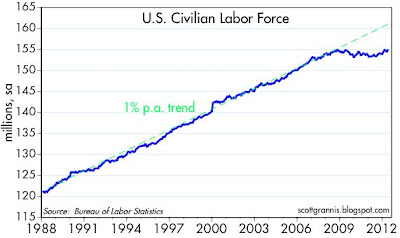
The unemployment rate ticked up last month, in part due to renewed growth in the labor force. The labor force is still way below trend, however, since some 5 million people have stopped looking for jobs, either because they have retired or have given up finding one. But if you look closely at the chart above, you will see that the labor force actually has been growing in fits and starts since last summer, and that is a positive sign. If the economy continues to slowly improve and the labor force continues to slowly expand, the unemployment rate is not likely to decline further, and could in fact rise some more, at least until the pace of jobs growth starts picking up.
So I think the market's reaction to today's news has been excessively pessimistic. I don't see convincing signs of deterioration in the outlook; I see an economy that continues to grow at a sub-par pace, and that's been the case for the most of the past three years.


 Posts
Posts


