Wednesday, July 8, 2015

China stock crash: index up only 72% in the past year


Things are a little crazy in China these days. As the chart above shows, stocks have crashed, falling by almost ⅓ in less than a month. That's one heck of a bear market. But stocks are still up 72% in the past year, and that's one heck of a bull market. On balance, the market value of Chinese stocks today is almost $3 trillion more than it was a year ago, and that's nothing to sneeze at. Meanwhile there has been a frenzy of trading, both as stocks rose and as they fell. 

This looks to me like an immature, lemming-style market (at one point it had risen over 150% from its year-ago lows) with inexperienced investors piling in as stocks rose to dizzying heights, and then selling in panic as prices started to return to more reasonable levels. And it hasn't helped that the government has been actively meddling, trying to keep prices from falling by pulling out all the stops—lowering reserve requirements, halting trading, banning short sales, suspending IPOs, relaxing lending standards, buying stocks, to name just a few. Instead of letting the market find its equilibrium—and educating investors in the process—the government is likely making the mistake of trying to keep stocks overvalued. Even if stocks fell another 20% (and I wouldn't be surprised if they did), they would still be up over 40% in the past year, and that would count as a great year by any measure.

It's all very unfortunate, and it's making people all over the world very nervous.

My recommendation: instead of worrying that the collapse of stock prices is going to trigger a collapse of the Chinese economy, I'd be thinking that what was a crazy-overvalued, bubble market just a few months ago is now coming back down to earth. China is not collapsing, it's learning how to deal with prosperity. 


I note that the Chinese yuan has been relatively stable for the past few years, and the central bank's foreign exchange reserves are massive and relatively stable as well. These are powerhouse numbers.


On an inflation-adjusted basis, and relative to a large basket of other currencies, the yuan has almost doubled in value since 1994. In dollar terms, the market value of Chinese stocks has skyrocketed from $330 billion in 2005 to just over $6 trillion today. The works out to annualized gains of over 30% for 10 years running, and that is simply spectacular. You can't ask for much more than that.

Tuesday, July 7, 2015

Greece is bad for gold

Despite the current fears that a Greek default and exit from the Eurozone will have damaging ripple effects, the price of gold continues to trend lower. At just under $1160/oz., it is almost 40% below its 2011 high of $1900. Gold hasn't benefited at all from the Greece turmoil—in fact, it's moved lower. What's going on? I think there are two things happening: 1) declining risk aversion and 2) a realization that the Greek problem is not such a big deal, as I pointed out in a post last week.


Gold needs lots of fear and trembling to move higher. Note that gold prices peaked in the latter half of 2011, right around the time that the PIIGS crisis peaked (second chart, which shows the yield on 2-yr government bonds). Several countries, larger and more important than Greece, were flirting with default in late 2011, and the world feared the collapse of the entire Eurozone. At the same time that gold prices peaked, government yields and 2-yr swap spreads were on the moon. Today, 2-yr Portugal yields are a mere 80 bps, while 2-yr Spanish yields are 42 bps; 2-yr Eurozone swap spreads are only 40 bps. Yields and swap spreads are way down, and gold prices are way down; it's all part of the same story—less panic, a bit more confidence, and liquid, functioning financial markets.

Gold is falling because Greece is not a major threat and there is little or no evidence of any systemic risk. As the first chart above suggests, gold is also falling because the demand for safe assets (e.g., gold and 5-yr TIPS) is falling. (Note that I've used the inverse of the real yield on TIPS as a proxy for their price.) The world is still quite risk averse, as I noted yesterday, and gold is still trading at elevated prices: over the last century, the real price of gold has averaged about $550/oz. But things are slowly getting less risky, and investors are slowly becoming a bit less risk averse.


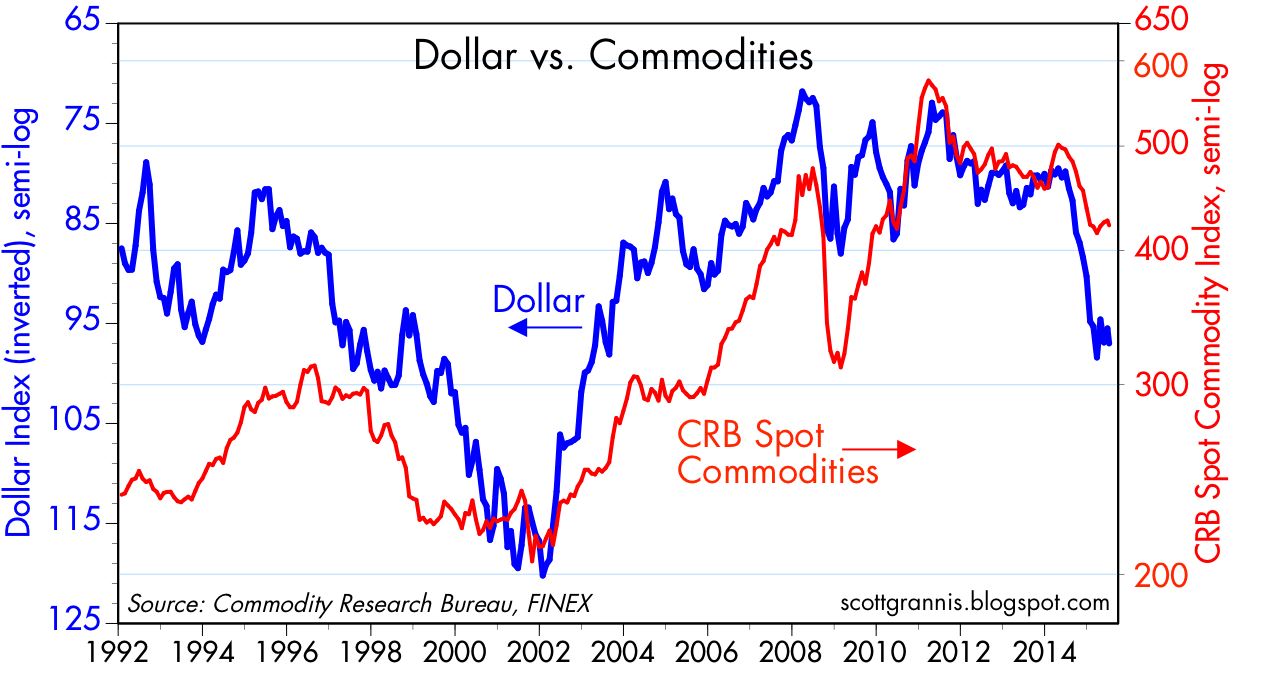
Gold is also falling because commodity prices are falling. Both are falling because on the margin the dollar has been strengthening. Gold and commodities are both a refuge of sorts when the dollar is weak and there are fears that monetary policies will lead to higher inflation. Markets are somewhat less concerned about that now, as inflation has remained quite low throughout the developed world even as central banks have been very accommodative.

Greece is bad for gold because Greece is not a compelling reason to pay up for the safety of gold.

Unless things take a big and unexpected turn for the worse, equity investors will find it hard to justify hiding out in cash, especially when cash pays nothing and yields on alternative assets (see chart below) are much higher, systemic risk is very low, monetary policy is accommodative, and there is no sign of any significant weakening in the economic outlook.


Monday, July 6, 2015

Service sector still healthy, so why are interest rates so low?

The ISM June service sector report came in as expected at 56.0, and that is consistent with a continuation of moderate growth in the biggest sector of the U.S. economy. Meanwhile, a similar report for the Eurozone shows conditions have been slowly improving for the past two years. We're still in a slow-growth economy, but nevertheless it continues to grow and conditions continue to improve. 

We've had six years of this, and with each passing month the rationale for zero short-term interest rates weakens. Years of near-zero interest rates are now the unique feature of the current business cycle expansion, but the reason for low interest rates is widely and commonly misunderstood. I think it's because central banks have conditioned global financial markets to view extremely low interest rates as "stimulative." Central banks want people to believe they are keeping rates low in order to "stimulate" economic growth. But despite trying really hard for many years to pump up growth, they but don't appear to have been very successful, because growth remains rather tepid. Is that because they haven't tried hard enough, or is there some other reason?

I've argued for many years that zero interest rates are symptomatic of a market that is risk averse. Interest rates on short-term, safe assets are low because the demand for them is very strong. Central banks have been obliged to accommodate this demand for safety by supplying tons of bank reserves. They've set interest rates low because that's where the market has driven them. They haven't been stimulative at all; you can see that by the fact that inflation remains very low. And of course, the premise that central banks can stimulate growth is highly questionable to begin with. Just how does a low interest rate environment stimulate growth? Growth comes from productivity, and productivity is the result of harder and more intelligent work, which in turn requires risk taking and motivation. Interest rates don't factor into the productivity—investment does. Besides, if low interest rates encourage borrowers to borrow, then they most likely discourage savers from saving. When the world is risk averse and wants to hold tons of cash and cash equivalents, investment is naturally weak, and that's why economic growth has been disappointingly slow. 


Bank savings deposits—which pay almost nothing in the way of interest—have doubled since the end of 2008, and are now approaching $8 trillion. They have quadrupled in the past 14 ½ years, rising at an annualized 15% per year! Yet they pay almost no interest; demand for the safety of deposits must therefore be intense.  


Service sectors in the U.S. and in the Eurozone are in decent shape, as the chart above shows.


The employment subindex fell from optimistic levels, but this series is notoriously volatile from month to month.


The business activity subindex is also at relatively healthy levels.

We're not going to see much in the way of stronger growth until economic policies increase the incentives to work and take on risk, and reduce the obstacles to investment.