Wednesday, June 8, 2016

Still more encouraging signs

The economy hasn't been doing too well this year, if we judge its health by reported GDP (a mere 0.8% annualized growth in the first quarter), the latest jobs number (a gain of only 38K jobs in June) and productivity (down at an annualized rate of 0.6% in the first quarter).

I've remained generally optimistic despite the disappointing headlines. For the past two months I've had several posts highlighting encouraging developments in the economy that suggested at the very least a recession was quite unlikely, and that hinted at a bit of improvement. Here are a few more encouraging developments that keep me optimistic:


The folks at Challenger, Grey and Christmas keep a tally of all the publicly-announced corporate layoffs. Last month was among the four lowest monthly totals in the past 17 years, as the chart above shows. The oil exploration and drilling sector of the economy was responsible for most of the outsized layoffs over the past year, but that is now a thing of the past. 


The active rig count (above) appears to have stabilized and even increased in the past week.


As the above chart of oil futures prices shows, oil prices have almost doubled since their low last February. The crisis in the oil patch is a thing of the past.


The BLS keeps a record of job openings across the economy. April's total was a record high—almost 5.8 million job openings. That's up 26% in the past two years. 


According to the Case-Shiller Home Price index, the average price of a home in the U.S. has increased over 30% in the past four years. As the chart above shows, the volume of new mortgage purchase applications (not including refis) is up over 50% since the beginning of last year. The housing market is definitely getting back on its feet.


As the chart above shows, industrial metals prices are up over 25% in the past 5 months. And it's not just because the dollar has weakened. Measured against the super-strong Swiss franc and Japanese yen, these same metals prices are up over 20% and 15%, respectively. This suggests that global industrial activity has firmed.


The chart above shows that the dollar value of the Brazilian stock market is up almost 70% in the past five months, helped, no doubt, by the rebound in commodity prices and the prospect of a new, less corrupt administration.


5-yr Credit Default Spreads, shown in the chart above, are an excellent indicator of credit trends. Spreads have been narrowing meaningfully for the past four months, and are now at levels that are consistent with conditions that are almost "normal." The bond market has recovered a good deal of the confidence it lost in the wake of the problems with China and in the oil patch. Spreads on high yield energy bonds have collapsed from a high of 2000 bps to now just over 800. Central banks' generous provisions of liquidity have allowed markets to adjust to wrenching changes without dragging down the entire economy. Healthy financial markets are the best kind of "shock absorber" for events in the real economy.


Bank lending has been constrained not by the Fed, but rather by a lack of confidence, a general desire on the part of businesses and households to deleverage, and by the strong, risk-averse regulations imposed on the banking industry by the Dodd-Frank law. Despite these headwinds, C&I Loans have been increasing at double-digit rates for the past several years.


Total Bank Credit has increased at an 8% annualized pace over the past 2 years. Yet despite these sizable increases in credit extended by the banking sector, leverage in the business and household sectors remains relatively low.


The news out of China has been improving on the margin in recent months. China's forex reserves (the red line in the chart above) have been relatively stable in the past four months, as has the yuan. Declining reserves would have meant that the central bank was pegging the currency at a level that was "too high" relative to the dollar. Relative to its trading partners, the Chinese currency has been stable for the past year or so.


Despite all these encouraging signs, 10-yr Treasury yields are down to very low levels. This suggests that the market is viewing the good news with a healthy dose of skepticism, fearful that things are more likely to deteriorate than to improve further. 

As I've argued for many years, risk aversion is still the order of the day.

Sunday, June 5, 2016

Recommended reading: Ikenson on trade

Cato's Dan Ikenson has written an excellent summary of trade issues, "Trade on Trial, Again." It's timely, considering the Trump's total confusion on the subject. Hint: running a trade deficit does not mean we are "losing." Here's a short version that hits what I think are the high points, but do read the whole thing:

Not long ago, a group of Cato scholars entertained the question of whether the intellectual debate for free trade had been won.
There was near consensus that it had — in 1776 with publication of The Wealth of Nations. In the 240 years to follow, efforts to poke substantive holes and refute Adam Smith’s treatise failed and, today, nearly all economists agree that free trade, by expanding the size of the market to enable greater specialization and economies of scale, generates more wealth than any system that restricts cross-border exchange. 
[But] ... how much does it really matter whether the intellectual debate has been won when, in practice, free trade remains stubbornly elusive, and the process of U.S. trade policy formulation is distinctly anti-intellectual? 
If the free trade consensus were truly meaningful, trade negotiations would be unnecessary. If free trade were the rule, trade policy would have a purely domestic orientation and U.S. barriers would be removed without need for negotiation because they would be recognized for what they are: taxes on consumers and businesses that impede the global division of labor and the creation of wealth.

[Unfortunately] ... The case for free trade is not obvious. The benefits of trade are dispersed and accrue over time, while the adjustment costs tend to be concentrated and immediate. To synthesize Schumpeter and Bastiat, the “destruction” caused by trade is “seen,” while the “creation” of its benefits goes “unseen.” We note and lament the effects of the clothing factory that shutters because it couldn’t compete with lower-priced imports. The lost factory jobs, the nearby businesses on Main Street that fail, and the blighted landscape are all obvious. What is not so easily noticed is the increased spending power of the divorced mother who has to feed and clothe her three children. Not only can she buy cheaper clothing, but she has more resources to save or spend on other goods and services, which undergirds growth elsewhere in the economy. 
Consider Apple. By availing itself of lowskilled, low-wage labor in China to produce small plastic components and to assemble its products, Apple may have deprived U.S. workers of the opportunity to perform that low-end function in the supply chain. But at the same time, that decision enabled iPods and then iPhones and then iPads to be priced within the budgets of a large swath of consumers. Had all of the components been produced and all of the assembly performed in the United States — as President Obama once requested of Steve Jobs — the higher prices would have prevented those devices from becoming quite so ubiquitous, and the incentives for the emergence of spin-off industries, such as apps, accessories, Uber, and AirBnb, would have been muted or absent. 
But these kinds of examples don’t lend themselves to the political stump, especially when the campaigns put a premium on simple messages. This is the burden of free traders: Making the unseen seen. It is this asymmetry that explains much of the popular skepticism about trade, as well as the persistence of often repeated fallacies. 
The benefits of trade come from imports, which deliver more competition, greater variety, lower prices, better quality, and new incentives for innovation. Arguably, opening foreign markets should be an aim of trade policy because larger markets allow for greater specialization and economies of scale, but real free trade requires liberalization at home. The real benefits of trade are measured by the value of imports that can be purchased with a unit of exports — our purchasing power or the so-called terms of trade. Trade barriers at home raise the costs and reduce the amount of imports that can be purchased with a unit of exports. 
Protectionism benefits producers over consumers; it favors big business over small business because the cost of protectionism is relatively small to a bigger company; and, it hurts lower-income more than higher-income Americans because the former spend a higher proportion of their resources on imported goods. 
[Fortunately] ... Even if there were a President Trump or President Sanders, rest assured that the Congress still has authority over the nuts and bolts of trade policy. The scope for presidential mischief, such as unilaterally raising tariffs, or suspending or amending the terms of trade agreements, is limited. But it would be more reassuring still if the intellectual consensus for free trade were also the popular consensus.

As for the TPP Treaty, we don't need it, because we should not be imposing any barriers  or conditions on our trade with Pacific nations. Or any nations, for that matter.


Friday, June 3, 2016

No improvement in the jobs market

The June employment report was much weaker than expected (+38K vs. +160K), but it's not necessarily the case that the engine of economic growth has virtually shut down. We've seen a half dozen very weak numbers like this over the past 5-6 years—it's the nature of this beast to be very volatile on a month-to-month basis. The monthly payroll numbers are simply not reliable enough to make confident judgments about the health of the economy, and, moreover, they can be revised significantly in the future.

What the report does tell us is that there is no sign of any fundamental improvement in the economy or the jobs market. There had been hints of improvement in past reports (e.g., a rise in the labor force participation rate and a quickening in the growth of the labor force), but they've been largely reversed now. As a result, it's likely that the economy is still plodding along at a miserably slow pace and will continue to do so unless and until there is a meaningful change to fiscal policy.  

The Fed will find it hard to raise rates given the lack of any fundamental improvement in the jobs market, but the market fully understands this and rates are priced accordingly (no rate hikes expected for at least a few months, 10-yr yields at 1.7%, very close to their all-time low of 1.4% which was registered in July '12). Inflation expectations remain subdued (at around 1.5%), notwithstanding today's jump in gold prices and drop in the dollar. Meanwhile, liquidity is abundant (2-yr swap spreads are still very low) and the market exhibits little or no sign of any systemic stress. All eyes remain glued to the presidential elections for clues to the future, few of which have been forthcoming to date. 


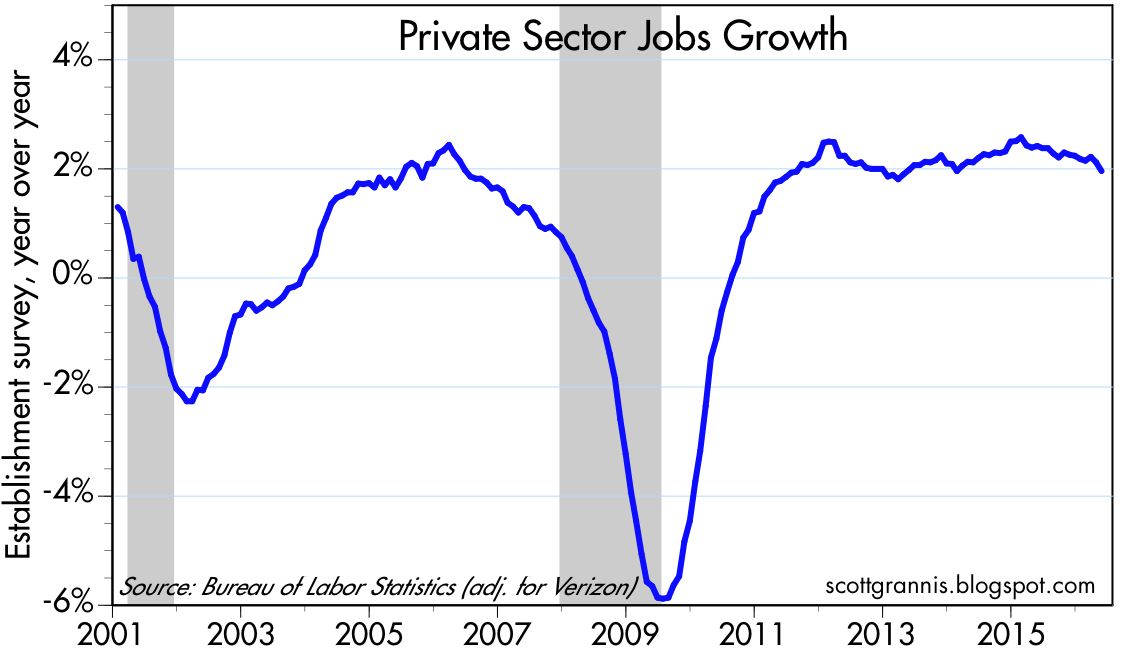
The first chart above shows how volatile the month-to-month numbers can be. I've adjusted the reported June number to reflect the fact that about 35K Verizon workers were on strike last month and thus were counted as unemployed. However, the strike has since been settled and they will be added back to the July jobs tally. We've seen about a half dozen weak numbers since the recovery began. As the second chart shows, the year over year growth in the labor force is still very much in line with what we've seen since 2011.


One reason to suspect that the June numbers were artificially low—and thus likely to be reversed in coming months—is the ADP report for June, which estimated private sector job growth to be 173K. These two series have tracked each other pretty well over the years, with the BLS series typically much more volatile. If the past is any guide, we'll see surprisingly strong jobs growth in the BLS numbers in coming months.


The unemployment rate dipped to a new cycle low, but mainly because lots of people apparently left the labor force, which we now see hasn't grown at all in the past five months. The labor force participation rate, which had begun rise earlier this year, now looks flat. At least things are not getting worse.