Thursday, January 14, 2016

Federal finances look good, but threaten to deteriorate

Six years ago the federal budget deficit peaked at almost $1.5 trillion, a staggering 10.2% of GDP. Last year it was only $475 billion, a modest 2.3% of GDP. That's some pretty significant progress that hardly anyone expected, and it was due mainly to spending restraint and the growth of jobs, incomes, and profits. 

Keynesian economists in 2009 would have predicted a massive recession/depression had you asked them to forecast the impact of such a huge reduction in the deficit. At the time (2009), they all predicted that a surge in spending (i.e., the ARRA) would jump-start the economy boost growth for several years, and they disagreed only about the size of stimulus spending, with most arguing for more rather than less. As it turned out, almost $1 trillion of "stimulus" spending gave us the slowest recovery on record. Ditto for the Fed's QE and massive purchases of notes and bonds, which did little if anything to stimulate the economy. All the government and policy intervention was for naught. From a supply-sider's perspective, it's more likely the case that massive government spending and policy intervention contributed to the economy's malaise.


Spending was flat from mid-2009 to late 2014, but since then it has resumed its upward trend, even as the economy slowed last year (which is not surprising from a supply-side point of view). Revenues, in contrast, rose over 60% from their early-2010 low. 


Relative to GDP, the picture looks pretty good. Spending currently is around 20.5% of GDP, just over one percentage point above its post-War average, and way down from its 2009 high. Revenues are coming in around 18.2% of GDP, also about one percentage above their post-War average. Unfortunately, they are unlikely to increase much further relative to GDP, since the growth of revenues has already slowed to 4-5% or less. Unless, of course, policies take a turn for the better (e.g., lower marginal tax rates, reduced regulatory burdens).


Last year's deficit was only slightly above its post-War average. If current conditions were to continue, the outlook for federal government finances would be sustainable for at least several years. Unfortunately, without entitlement reform, spending could rise significantly in the years to come. Transfer payments last year totaled over $2.7 trillion, almost 73% of total federal spending and 15% of GDP! Needless to say, transfer payments don't contribute to GDP, since they involve taking money from taxpayers and giving it to people who likely are not working or not paying much in taxes (e.g., retired, disabled, lower income). We need reform in Washington for the outlook to brighten.


Individual income taxes (which include taxes on dividends and realized capital gains) were the main engine behind revenue growth, rising at an annualized rate of 10.2% over the past six years. Despite disappointingly slow economic growth last year, individual income taxes last year increased 9%. Payroll taxes (FICA) didn't grow nearly as fast, however, thanks mainly to the slow recovery in jobs and a payroll tax holiday in 2011 and 2012, but they rose 5.4% last year, despite the modest 1.9% growth in jobs.

Tuesday, January 12, 2016

Lots of stupidity on both sides of the aisle

Don Boudreaux reminds us that lots of voters in both parties are "utterly ignorant of the ways that economies and governments work ... [and] in equal parts mindless, bigoted, and uncivilized. They are, in short, dupes for power-mad despots-in-waiting."

Read the whole thing, it's not too long. Reading Don's website periodically is an excellent and free education in economic thinking.

Friday, January 8, 2016

No change in the jobs picture

The December jobs number was much stronger than expected (292K vs. 200K), but one month in this volatile (and often revised) series is not enough to call a trend. As I see it, private sector jobs have been growing by a little more than 200K on average per month for the past several years, with no substantive change. If the December number is significant at all, it's because it undermines fears of a growth slowdown or recession. And given the market's weak expectations for growth, that's a positive. For now, the market appears to be obsessed with developments overseas, even if they are unlikely to have a significant impact on the U.S. economy one way or the other. How many are aware that U.S. exports to China account for less than 1% of our annual GDP? In the highly unlikely event that China cut its purchases of U.S. goods and services by half, that would amount to a $60-70 billion hit to GDP, and that's almost a rounding error.


The chart above illustrates my first point above. On average, the private sector has been creating a little over 200K jobs ever months for a long time. In this context, December's report was simply more of the same. We'd have to see at least 2 or 3 more strong numbers before getting excited.


The trend in private sector jobs growth is a little over 2% per year. Add that to the 0.6% increase in  labor productivity over the past 3 and 5 years and you get a GDP growth expectation of 2.7%. Nothing to get excited about, but it sure beats what's going on in most other developed countries. And consider this: the incremental growth of the U.S. economy this year will likely be almost as much as the entire annual output of Argentina.


One bright spot is that the growth of the civilian labor force (those who have a job or are looking for a job) has inched up to about 1% per year. But it's still the case that some 10 million people appear to have dropped out of the labor force (i.e., relative to past trends, there is a shortfall of about 10 million people in the labor force).


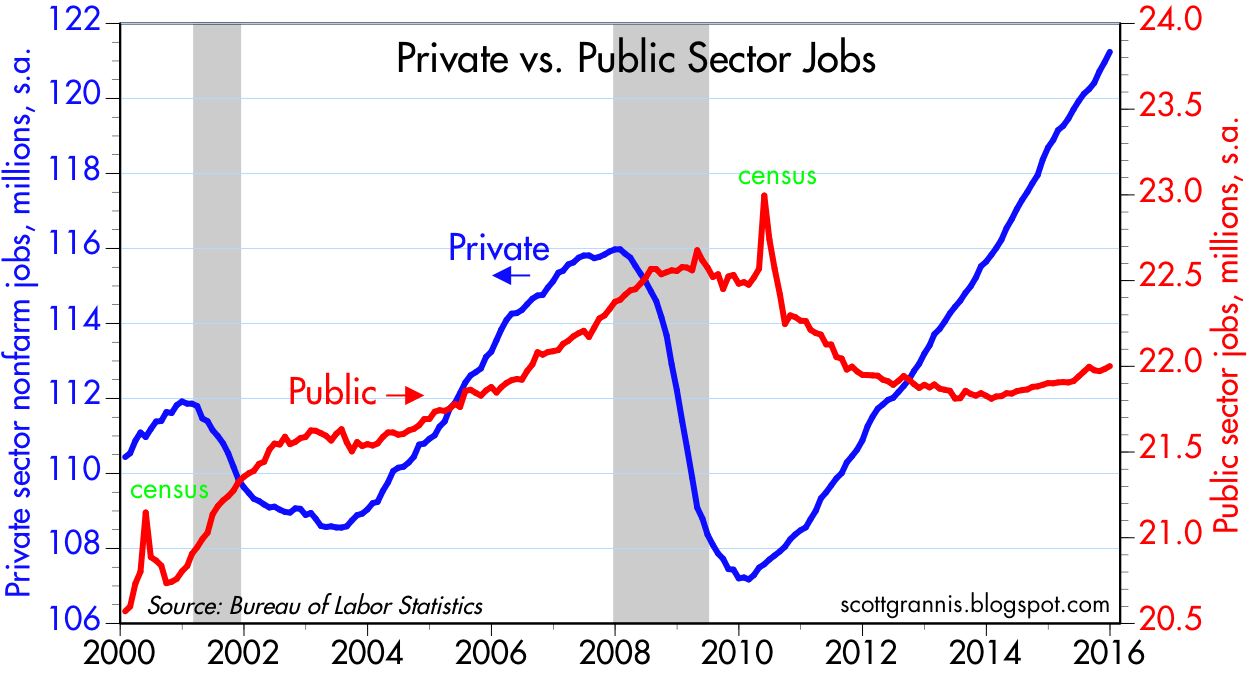
Another bright spot is the very slow growth of public sector jobs in the current business cycle expansion. The private sector is what powers the whole economy and pays the salaries of the public sector. The public sector has been shrinking relative to the rest of the economy for six years now, and that has freed up resources for the more productive private sector.