

 Posts
Posts


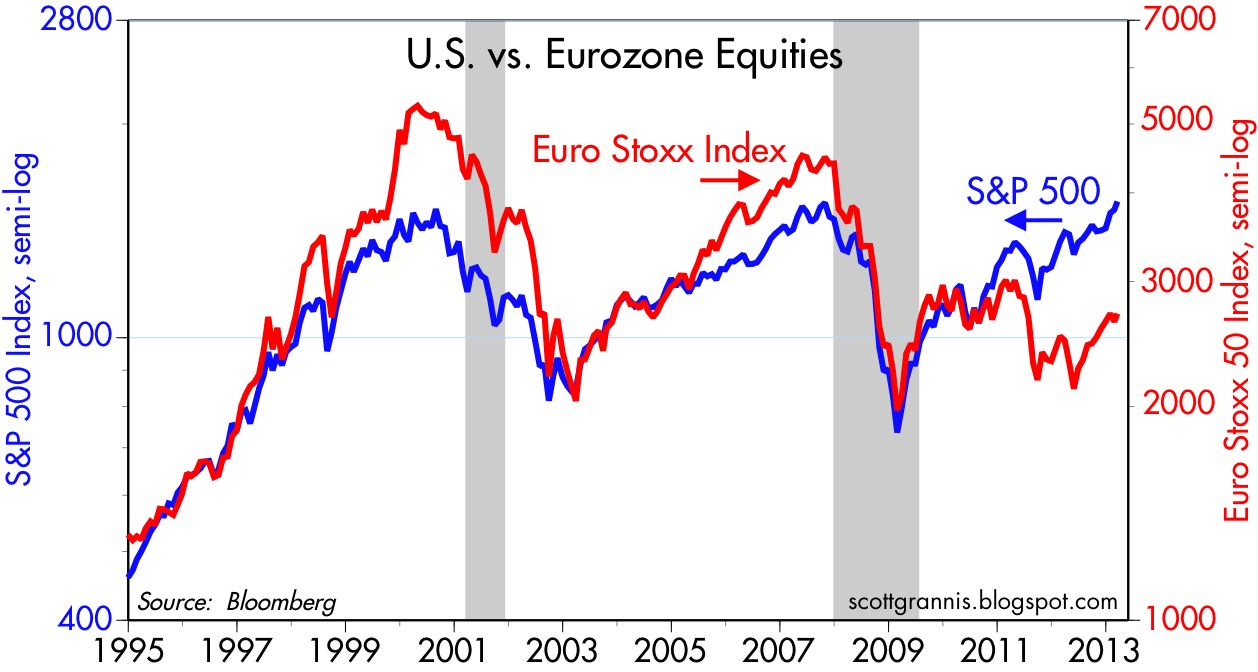

The first chart above compares the S&P 500 Index to the Euro Stoxx 50 Index. Note how the correlation between the two has been relatively high for a long time (both tend to rise and fall at the same time). Note also how Eurozone stocks were more volatile than U.S. stocks up until the last recession, as Eurozone stocks rose more and fell more than their U.S. counterparts. But in the past 6 years, U.S. stocks have strongly outperformed Eurozone stocks, as shown in the second chart above. Since early 2007, U.S. stocks are up 70% vis a vis Eurozone stocks, even after taking account of currency fluctuations (the Euro today is trading at the same level vis a vis the dollar as it was in early 2007). This is reflected in the second chart above, which is the ratio of the S&P 500 to the Euro Stoxx 50 Index.

The outperformance of the U.S. can also be seen in the chart above, which compares Industrial Production Indices for the U.S., Germany, and the Eurozone. Initially, Germany enjoyed a more powerful recovery from the last recession, but in the past 18 months, German industrial production has declined 4%, while U.S. industrial production has risen almost 6%. U.S. industrial production has increased 10% relative to Eurozone industrial production since early 2011.
I think it's significant that the U.S. has done so well in recent years, considering how weak the Eurozone has been. The U.S. economy is slowly but surely expanding, while the Eurozone economies suffer through what amounts to a double-dip recession. Eurozone troubles have not proved contagious, but surely the troubles in Europe have acted as headwinds to U.S. progress.
This is a good example of why it never pays to underestimate the ability of the U.S. economy to overcome adversity.


