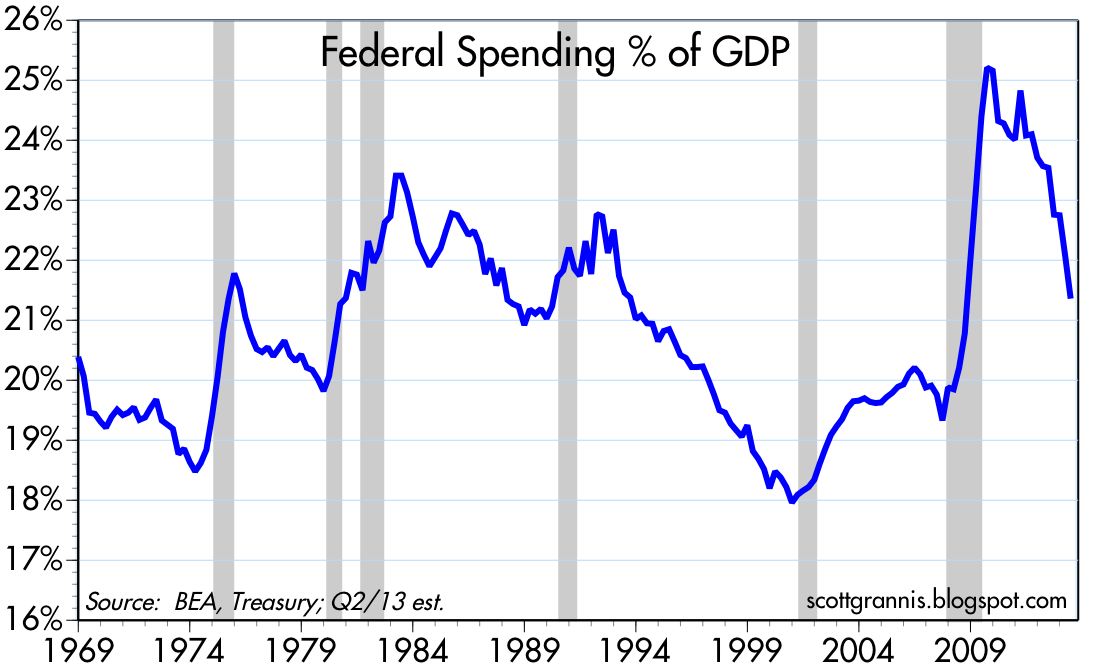
This is the best and most under-appreciated news that I am aware of today: Over the past four years, and especially in the last 12 months, there has been a dramatic improvement in the federal budget outlook. Revenues have grown at double-digit rates of late, while spending has slumped. As a result, the budget deficit has plunged, both in nominal terms and relative to GDP. Almost two-thirds of the decline in the burden of the deficit since 2009 has come from the spending side, and that is good news since it leaves more room for the private sector—the source of most productivity gains—to expand.
Federal spending fell 6% in the year ending June 2013, by far the biggest one-year decline in the past 43 years. Relative to GDP, spending has declined by almost four percentage points over the past four years, from a peak of 25.2% to 21.4%.
Revenue rose over 13% in the year ending June 2013. Relative to GDP, revenue has increased by a little over 2 percentage points, from a low of 14.6% in 2009 to now 17%.
The deficit has declined from a high of 10.5% of GDP in 2009 to now only 4.4%. In dollar terms, it has fallen by more than half, from a high of $1.48 trillion to just under $0.7 trillion.
A variety of forces are at work behind the scenes of this dramatic improvement. Congress has been deadlocked for several years and unable to agree on new spending legislation. The budget sequester has kept some spending from increasing. The economy has been slowly but steadily improving, generating some 7 million new jobs, an almost $2 trillion increase in personal income, and about a one-third organic increase (i.e., unrelated to higher tax rates) in personal income tax receipts. The number of people receiving unemployment insurance has declined by more than 7 million, thus reducing "safety net" spending. Marginal tax rates have increased on upper income earners, causing many to accelerate income and capital gains realizations. Corporate profits have increased some 65%, and taxes paid by corporations have more than doubled, from a low of $122 billion in 2009 to $272 billion in the past 12 months.
From a Keynesian perspective, it's remarkable how well the economy has done in the past four years given what has amounted to a huge and wholly unexpected increase in fiscal austerity (i.e., a 6 percentage point reduction in the budget deficit relative to GDP). From a supply-side perspective, it's refreshing to see how much can be accomplished by the private sector in the face of serious fiscal headwinds (e.g., big increases in regulatory burdens and rising marginal tax rates): even just 2% GDP growth per year can solve lots of problems if the government gets out of the way.
This is all very encouraging because the huge decline in the deficit—which is now back to levels that are quite manageable—all but eliminates the need for still-higher tax rates. Indeed, it even opens up the possibility of lower tax rates in the future. The
bi-partisan tax reform effort now underway, led by Sen. Max Baucus and Rep. Dave Camp, could produce dramatic pro-growth results if done correctly. That would be the best news I could hope for, outside of a permanent delay to Obamacare, which would almost certainly boost federal spending with little or no benefit to the economy.


 Posts
Posts